
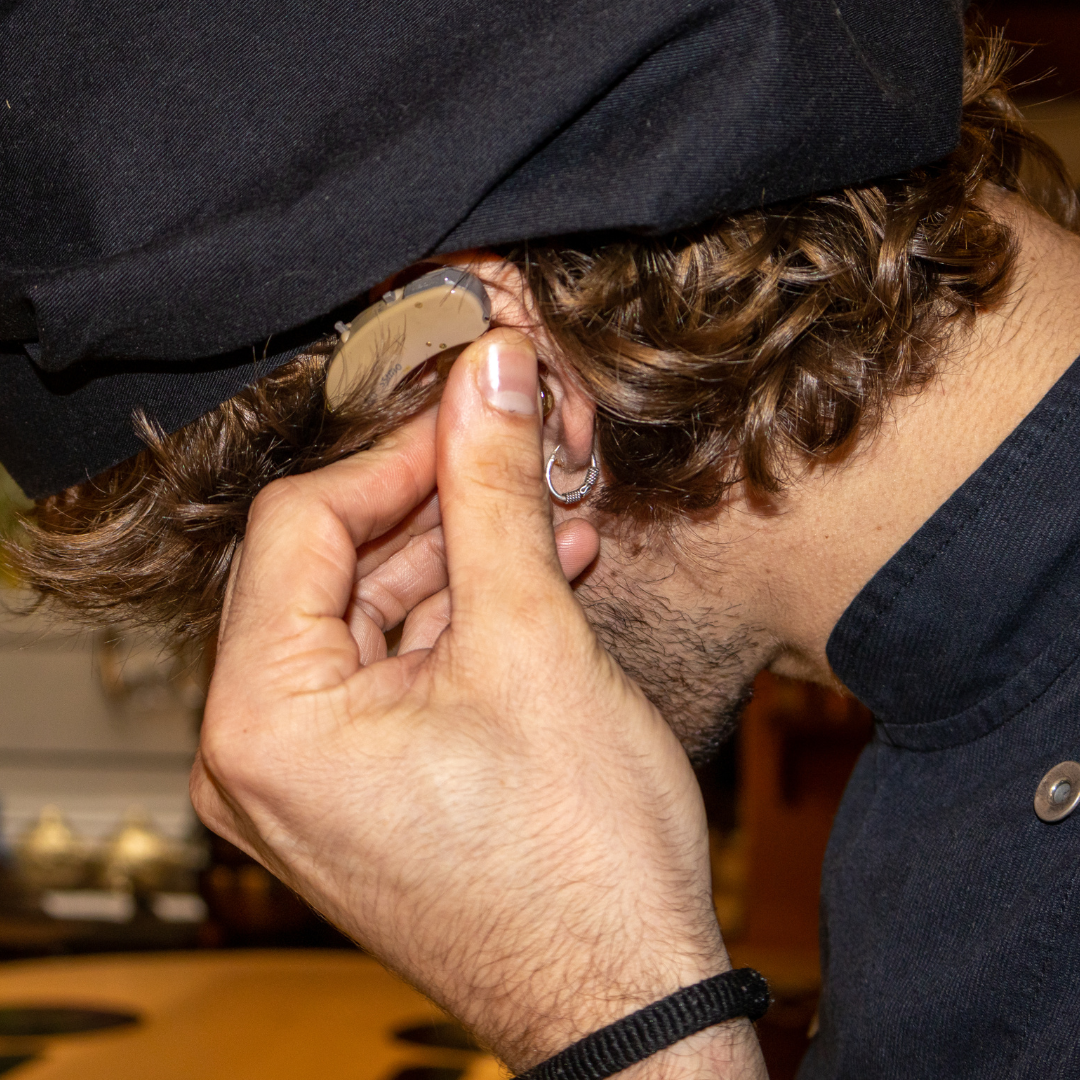
Restaurant conversations can be difficult to follow when environmental noise competes with your focus and hearing. We perform comprehensive diagnostic assessments to evaluate hearing in quiet rooms and challenging acoustic spaces to identify functional deficits. Once we determine the cause of difficult hearing, we can help you find personalized solutions.
Understanding the Contrast Between Quiet Hearing and Restaurant Noise
Low-noise environments yield an advantageous signal-to-noise ratio where primary speech remains significantly louder than background sound. Dining venues establish an entirely contrary auditory challenge. Layered diner voices, kitchen activity, foreground music, and room reverberation muddy speech signals, requiring intense mental strain to follow dialogue.
Such difficulty frequently signals sensorineural high-frequency hearing loss, auditory processing dysfunction, or noise-induced cochlear damage. Attention, fatigue, dim lighting, and distance from the speaker may make it worse. Some people have normal results on a basic hearing test but still perform poorly on speech-in-noise testing. Disproportionate difficulty in restaurants justifies professional clinical assessment even if your everyday home hearing appears intact.
How Audiologists Identify High-Frequency Hearing Loss
We begin with a history of the situations that cause trouble, along with questions about noise exposure, tinnitus, medications, family history, and changes in either ear.
Clinical pure-tone audiometry identifies hearing threshold levels across various frequencies by delivering sounds through air and bone pathways. Patients with high-frequency hearing loss typically exhibit a sloping audiogram configuration where sensitivity steadily declines at elevated pitches. Diagnostic evaluations may also integrate acoustic tympanometry to check middle-ear pressure alongside word-recognition testing to evaluate speech processing.
Standard quiet test booths fail to simulate real-world restaurant noise, making speech-in-noise testing a crucial clinical tool. It measures how well you recognize words or sentences as competing sounds become louder. Combined, these clinical findings determine whether your symptoms stem from acoustic audibility, word clarity, central noise filtering, or multifactorial causes.
How Auditory Processing Difficulties Impact Adult Hearing
An auditory processing disorder affects how the central auditory nervous system interprets sound. Even when the ears detect individual frequencies accurately, the central auditory system may falter at sorting overlapping voices, distinguishing close speech sounds, or processing fast-paced dialogue. We first evaluate peripheral hearing and then determine whether an individualized auditory-processing test battery or referrals to other professionals are appropriate.
Behavioral Strategies for Hearing Clearly in Loud Venues
Minor environmental adjustments can boost speech acoustic signals and supply critical visual lip-reading cues. Prior to dining, choose venues known for lower noise levels or schedule meals during quieter dining hours. Dining locations utilizing sound-absorbing elements like booths, felt panels, window curtains, and carpet offer better acoustics than high-ceilinged rooms with hard surfaces.
Practical seating strategies in the dining room:
- Request table placement positioned away from dishwashing stations, bustling bars, sound speakers, and celebratory gatherings.
- Position yourself with your back toward a solid partition to dampen intrusive background noise from behind.
- Face your speaking partners directly in well-illuminated seating to maximize visual speech cues.
- Keep the distance between speakers as short as comfortably possible.
- Turn your better-hearing ear toward the specific speaker you want to hear most clearly.
- Ask speakers to reword the specific phrase you missed rather than repeating their initial wording.
- Validate significant pieces of information directly rather than feigning understanding during dialogue.
- Excuse yourself for a momentary quiet pause when listening exhaustion starts to mount.
- Invite companions to focus on clear articulation and a measured, comfortable cadence.
- Raised or shouting voices warp acoustic phonetics and rarely improve speech intelligibility.
Assistive Listening Technologies for Noisy Environments
Selecting the ideal assistive technology depends upon underlying diagnosis, specific acoustic challenges, and verified hearing loss. Prescription hearing aids fitted by an audiologist leverage directional microphone arrays, advanced digital noise reduction, and dedicated restaurant programs to focus on frontal speech while dampening background sound. Users should establish realistic expectations because no hearing device can fully eradicate all unwanted ambient speech.
Remote wireless microphones offer an exceptional boost to the signal-to-noise ratio in challenging venues. Positioned near or clipped to the speaker, the device transmits raw speech audio directly to paired hearing aids or external listening receivers. This wireless transmission substantially diminishes the acoustic degradation caused by physical distance and ambient room noise.
Additional effective assistive technologies include:
- Dedicated table microphones engineered to capture small-group dialogue
- Telecoils or hearing-loop systems in equipped venues
- Real-time smartphone speech-to-text transcription and live-captioning apps
- Consumer wireless earbuds or hearables featuring customizable assistive listening modes
- Sound-level or restaurant-review tools for finding quieter locations
We evaluate these technological options, ensure full hardware compatibility, and instruct you on maximizing your selected system.
Professional Audiological Solutions for Loud Listening Environments
A comprehensive hearing evaluation looks far beyond the common misconception of “I hear fine in quiet environments.” Our audiology team assesses the unique environments, speaking partners, and ambient noise profiles that challenge you to choose targeted diagnostic tools. The assessment may include pure-tone thresholds, middle-ear testing, word recognition, and speech-in-noise measures. Central auditory-processing testing is considered whenever clinical intake and initial test outcomes point toward higher-order deficits.
Rapidly progressing, asymmetrical, or sudden hearing decline warrants an urgent clinical referral to an ear, nose, and throat physician. Individualized diagnostic care pinpoints the precise physiological etiology rather than merely blaming restaurant noise for communication struggles.
Schedule a Hearing Evaluation Today
If noisy restaurant gatherings leave you struggling to follow dialogue, pulling away, or feeling completely drained, schedule an audiological evaluation with our team. Our clinical team will determine the best strategies to improve your hearing in noisy environments through custom hearing-aid programming, remote microphones, or targeted auditory rehabilitation.
Reach out to our audiology clinic today to schedule an evaluation and begin enjoying clear, effortless conversations.
